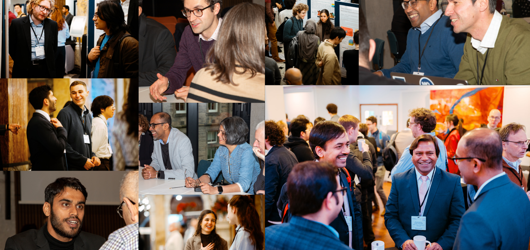
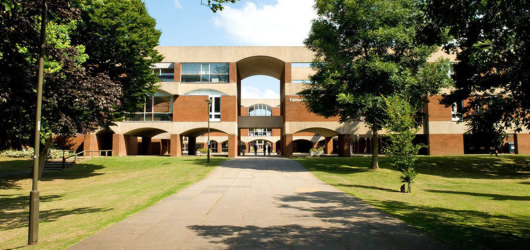
NeuMat recently sponsored a full-day “Future of Compute” workshop, held on 22 April at the University of Cambridge, that brought together researchers, entrepreneurs, and investors working across materials, devices, circuits, algorithms, and systems. The event exemplified NeuMat’s mission to foster cross-disciplinary dialogue and full‑stack integration in emerging compute technologies.
The workshop was organised by Dr Markus Hellenbrand, Dr Abin Varghese, and Professor Andrew Flewitt, and attracted around 50 participants from a wide range of backgrounds, including physics, materials science, electrical engineering, and computer science. Attendees represented academia, start-ups, investors, and public-sector organisations, reflecting the diverse ecosystem required to drive new computing paradigms from fundamental research to real-world impact.
Showcasing Cambridge’s Future Compute Ecosystem
The first session of the day provided a snapshot of ongoing future compute activities across Cambridge. Speakers highlighted research directions, spin‑out activity, enabling facilities, and policy considerations, painting a picture of a uniquely strong local environment for innovation.
Contributions included:
- Dr Markus Hellenbrand on materials and devices for in‑memory computing
- Dr Apollo Matsoukas on non‑von‑Neumann algorithms through NeuroSYNC
- Dr Aga Iwasiewicz‑Wabnig, Director of the Maxwell Centre, on industry engagement and facilities
- Professor Robert Mullins on lowRISC, CommonAI, and ARIA’s Scaling Compute programme
- Professor Ross King on DNA computing
- Professor Andrea Ferrari, Director of the Cambridge Graphene Centre, on graphene and 2D materials through the CamGraPhIC programme
- Dr Hashini Thirimanne (Wiley), a co‑sponsor of the event
Collectively, the session underscored Cambridge’s depth of expertise and infrastructure. At the same time, speakers emphasised that delivering future computing technologies will require stronger communication and coordination across disciplinary boundaries—a core motivation for NeuMat’s support.
Learning from Start-ups and Spin-outs
A dedicated start-up session showcased examples of successful translation from university research into commercial technology development. Speakers included:
- Professor Adnan Mehonic (IntrinSic Semiconductor Technologies)
- Will Keen (Fractile)
- Dr Bruno Jansen (imec)
The session highlighted how innovation at different levels of the stack—from materials and devices to architectures and system integration—can follow parallel and complementary paths. Together, these examples demonstrated that there is no single route to impact, but that co‑existing approaches are essential to the evolution of future compute platforms.
From Public Funding to Private Investment
In a dedicated investor session, speakers Dr Matthew Wells (Cambridge Enterprise), Dr Paul Larcey (Innovate UK), and Emmi Nicholl (Cambridge Angels) discussed the funding landscape for deep‑tech ventures. A key message was the importance of planning for the transition from public funding to private equity, and of aligning technical milestones with commercial expectations early in the development process.
Looking Ahead: Building Momentum
The workshop concluded with a plenary discussion focused on next steps. Participants identified cross‑disciplinary communication as a key enabler for full‑stack progress, and proposed a range of follow‑on activities, including regular PhD presentation forums, networking events, principal‑investigator focus groups, and sandpit-style workshops. The organisers have already scheduled follow‑up meetings to develop several of these ideas further.
By sponsoring the “Future of Compute” workshop, NeuMat reinforced its commitment to connecting communities, accelerating translation, and enabling new materials and device concepts to be developed in concert with architectures, algorithms, and applications.