What is on offer
Selected principal investigators may receive up to £100,000, paid in arrears, for a twelve-month project starting 1 January 2027. Proposals must be built around at least one of APRIL's four flagship tools:
● EMOS (Electronic Materials Ontology System) – an open-source framework unifying crystal databases, generative models and ML property predictors into end-to-end material-to-device design pipelines. APRIL specifically highlights extension into neuromorphic devices as a potential direction.
● LaMDA (Language Model-assisted electronic Design Automation) – integrates large language models with commercial EDA tools to generate and refine circuit netlists, Verilog HDL and design constraints across analogue, digital and RF flows.
● PRAMANA (Proof-centric RTL Agentic Model for Assurance, Narrative, and Automation) – an agentic framework for formal assurance of register-transfer-level hardware designs, connecting AI-generated verification artefacts to executable formal checks.
● STARS (Semiconductor Traceability and AI-assisted Research System) – a scalable AI platform for automated testing of emerging electronic devices such as memristors and TFTs, delivering up to a threefold speed-up in daily measurement throughput.
All outcomes must be open-sourced, align with the APRIL vision, and include a clear vision-to-impact statement. Award recipients are expected to participate in APRIL summit events, attending in 2026 and presenting in 2027 and 2028.
Why this matters for NeuMat
The tools on offer speak directly to challenges NeuMat members already grapple with: navigating materials complexity in novel nanoelectronic devices, accelerating device-to-circuit design, and building trustworthy, well-characterised data pipelines for emerging memory and neuromorphic technologies. EMOS's suggested extension into phase-change memory and neuromorphic devices, and STARS's proven track record accelerating memristor characterisation, are particularly close to NeuMat's own materials-and-devices remit. This is a genuine opportunity to bring neuromorphic hardware perspectives into APRIL's toolset, and to secure meaningful funding while doing so.
Key dates
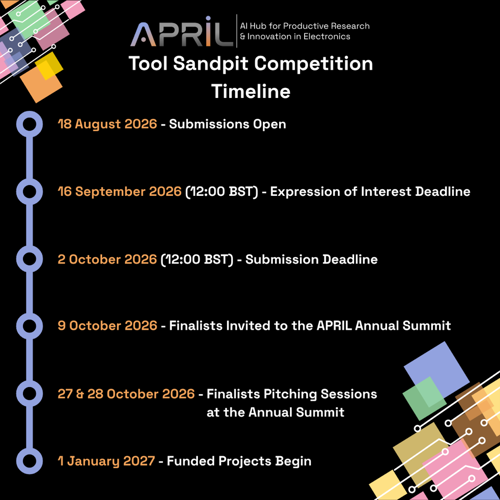
● 17 August 2026 – Submissions open
● 16 September 2026, 12:00 BST – Expression of Interest deadline
● 2 October 2026, 12:00 BST – Full proposal deadline
● 9 October 2026 – Finalists invited to pitch at the Annual Summit
● 27–28 October 2026 – APRIL AI Hub Annual Summit, Sheffield (finalists required to attend in person)
● 1 January 2027 – Projects commence
How to apply
Proposals should not exceed three pages (excluding appendices) and must be submitted as a PDF using APRIL's proposal template. Full eligibility criteria, tool documentation and the proposal template are available on the APRIL blog.
Call for Proposals (full details): https://www.april.ac.uk/blog/opportunities/sandpit-competition-2026-call-for-proposals/
Expression of Interest form (due 16 September): https://forms.cloud.microsoft/e/ahHmW4waAB
Proposal submission form (due 2 October): https://forms.cloud.microsoft/e/8pWhbYMsXP
Spread the word
APRIL has announced the competition on LinkedIn, with further posts from the tool leads: Dr Cristian Sestito on LaMDA and Dr Atish Dixit on EMOS. NeuMat members are encouraged to share these posts within their own networks and departments.
APRIL AI Hub announcement: https://www.linkedin.com/feed/update/urn:li:activity:7495785405028663296
Dr Cristian Sestito on LaMDA: https://www.linkedin.com/posts/cristian-sestito-ba5a89193_aprilaihub-artificialintelligence-ai-activity-7496116784148951040-sfBB
Dr Atish Dixit on EMOS: https://www.linkedin.com/posts/atish-dixit-14461518_materialsscience-semiconductors-aimaterials-activity-7496231232641622016-EW91
Queries about the competition can be directed to the APRIL AI Hub team: april@ed.ac.uk